
 Austria
 Belgium
 Estonia
 Finland
 France
 Germany
 Greece
 Iceland
 Ireland
 Italy
Italy
 Liechtenstein
 Netherland
 Norway
 Poland
 Portugal
 Spain
Spain
 Sweden
 Switzerland
 Turkey
 United Kingdom
 Australia
 Fiji
Fiji
 Hong Kong
 India
India
 New Zealand
 Indonesia
 Japan
Japan
 Malaysia
 Philippines
 Singapore
 Thailand
 Brazil
 Chile
Chile
 Colombia
 Peru
Peru
 Mexico
 USA
USA
 Bahrain
 Morocco
 Oman
Oman
 UAE
UAE
 Saudi Arabia
 Tanzania
The risk beyond the firewall: Why vendor failures have become a boardroom issue for banks

 Prefer us on Google


Banks have never operated in isolation. Outsourcing has always been part of the industry whether that's payment processing, customer support, collections, or core banking technology. But today's operating model looks very different from what it did even a handful of years ago.
Banks now rely on an ecosystem of cloud providers, fintechs, software vendors, managed service providers, and digital infrastructure partners to keep the lights on and deliver the seamless digital experience customers expect. This ecosystem brings speed, innovation, and efficiency while also creating a very uncomfortable reality. Your organisation is only as resilient as the weakest critical supplier in your chain.
According to the World Economic Forum's Global Cybersecurity Outlook, supply chain cyber risks remain one of the fastest-growing concerns for organisations globally, with increasing dependence on third parties making cyber resilience significantly more challenging. Similarly, IBM's Cost of a Data Breach Report shows that breaches involving third parties often take longer to identify and contain, driving up both operational disruption and financial costs.
The challenge for banks today isn't just protecting their own systems anymore. It's understanding, monitoring, and governing risks that sit outside their own four walls.
Because when a critical vendor experiences a cyber-attack, operational failure or prolonged outage, customers don't see "the supplier had an issue." They see their bank isn't working.
And regulators? They generally expect the bank, not the vendor, to demonstrate that appropriate oversight, governance and contingency planning were in place. In many cases, the incident happens to the vendor but the consequences land with the bank.
This expectation is increasingly being formalised through regulation. In the United Arab Emirates, the Central Bank's Outsourcing Regulation for Banks requires institutions to undertake appropriate due diligence, approval, and ongoing monitoring of outsourced arrangements, with a clear emphasis that outsourcing must not diminish a bank's obligations to customers or regulators.
Across the wider GCC, regulators have adopted a similar philosophy. The Saudi Central Bank (SAMA), Central Bank of Bahrain (CBB), Central Bank of Oman (CBO) and Qatar Central Bank (QCB) have all strengthened their focus on operational resilience, cyber security and outsourcing governance, placing greater responsibility on financial institutions to identify critical third parties, assess concentration risk, maintain effective business continuity arrangements and exercise continuous oversight of key service providers. While the specific requirements vary by jurisdiction, the underlying message is consistent: banks may outsource activities, but they cannot outsource accountability.
As a result, third-party failures are increasingly viewed not only as operational or technology incidents, but also as governance events that raise questions around vendor selection, risk assessment, oversight and Board-level supervision.
Third-party risk isn't just an IT problem anymore
For years, vendor management largely sat with procurement, operations, or technology teams. However, that simply isn’t enough anymore as a failure at one critical provider can quickly become an enterprise-wide issue, affecting everything from operations and customer trust to regulatory compliance and board oversight.
Depending on the nature of the incident, the fallout can include:
- Service outages preventing customers from accessing banking services
- Delayed or failed payment processing
- Customer data being compromised
- Fraud and financial crime losses
- Regulatory investigations and remediation costs
- Significant reputational damage
- Increased scrutiny of senior management and the Board
As banks become increasingly interconnected, the question isn't whether third-party risk exists, it’s whether organisations truly understand where those critical dependencies sit and whether they've built enough resilience around them.

When vendor risk becomes a governance issue
One thing we have noticed is that after a major operational incident, conversations rarely stay technical for very long. The focus quickly shifts.
Not to what happened. But to who knew what and when.
Questions start being asked around governance rather than technology.
• Was the vendor appropriately vetted?
• Were cyber controls independently assessed?
• Did management understand concentration risk?
• Was the Board receiving meaningful reporting?
• Were contingency plans actually tested?
• Were early warning signs missed?
These aren't technology questions, they're governance questions. And that's exactly why vendor risk has become a Board issue rather than simply an operational one.
This is also reflected in global regulation. Frameworks such as the Basel Committee's Principles for Operational Resilience and guidance from regulators around the world increasingly expect financial institutions to identify critical third parties, test resilience, and maintain effective oversight throughout the relationship, not just during onboarding.
The financial impact is rarely limited to one loss
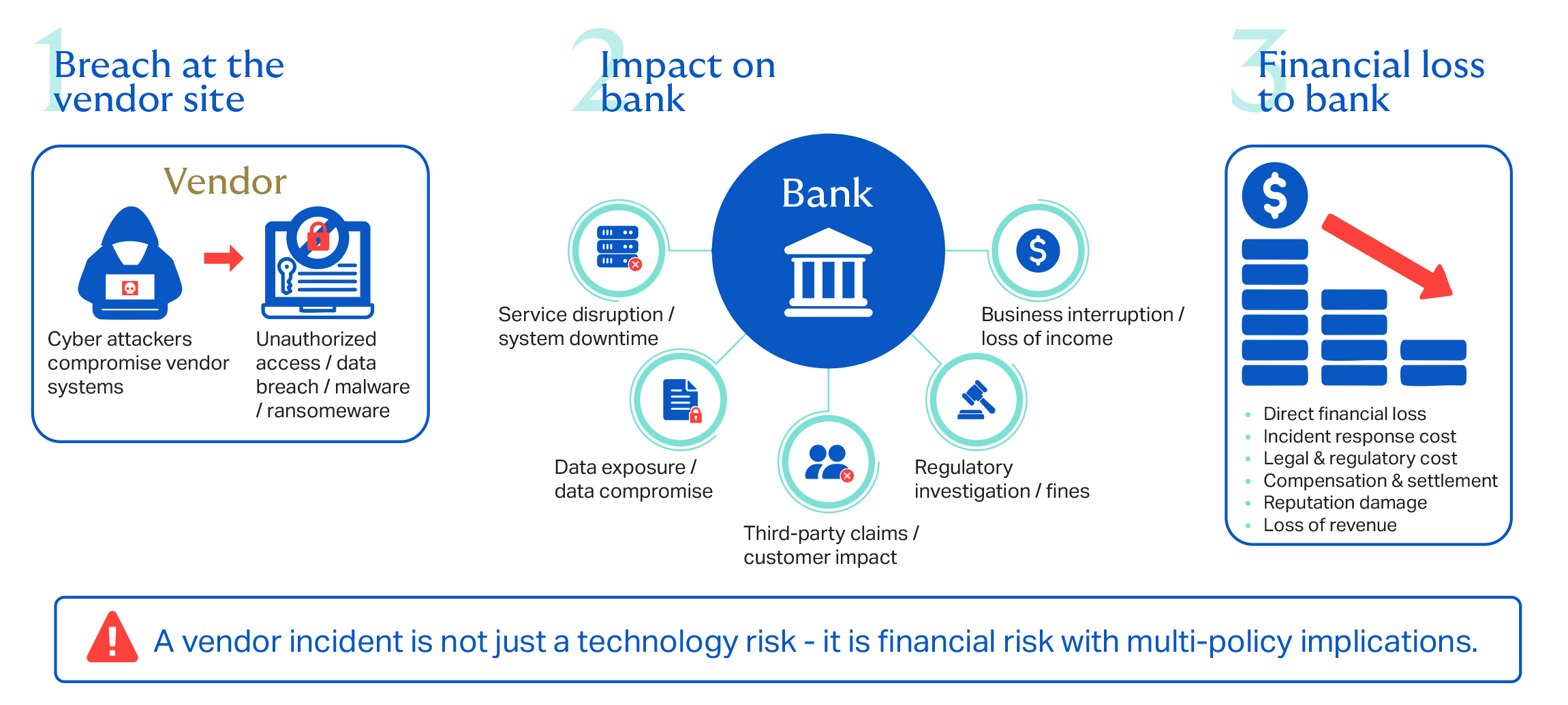
One of the biggest misconceptions around third-party incidents is that they create a single problem. They often trigger multiple losses at the same time.
A cyber incident at a critical supplier could lead to customer claims, regulatory investigations, operational disruption, fraud losses and reputational damage, all stemming from one event.
Those losses may include:
- Legal liability: Customers may seek compensation where service failures, delayed transactions or data breaches cause financial loss.
- Financial crime: If cybercriminals exploit weaknesses within a vendor environment, banks may suffer direct losses through theft, fraudulent transfers or other criminal activity.
- Business interruption: Extended outages can interrupt revenue-generating activities while significantly increasing operational and remediation costs.
- Reputational damage: Trust takes years to build and minutes to lose. In banking, reputation is often one of the most valuable assets an institution has and one of the hardest to restore after a high-profile incident.
- Regulatory scrutiny: Financial regulators continue placing greater emphasis on operational resilience, outsourcing governance, and cyber preparedness. Simply having a contract with a vendor is no longer enough. Institutions are increasingly expected to demonstrate ongoing oversight of critical suppliers.
The important question isn't simply "Do we have these covers?"
It's "Have they been structured with our third-party exposure in mind?"
Because many organisations spend considerable time strengthening internal controls while underestimating how much of their risk now sits outside the organisation altogether.
Final thoughts
The future of banking is only becoming more interconnected.
Cloud adoption will continue to grow.
Fintech partnerships will become deeper.
Technology ecosystems will become more complex.
None of that is a bad thing.
But it does mean organisations need to think differently about operational resilience. The goal isn't to eliminate third-party relationships as that is simply unrealistic.